
I have been saying that the table is shaking and that the people who built it are the ones who have to steady it. That is true. But it is not yet an ask, and I have been in this work long enough to know what happens to a true thing that is never turned into an ask. It gets quoted. It gets applauded. It changes nothing.
So let me make the ask, and let me be clear about the spirit of it. I am in no position to instruct any of you, and I would not want to be. Many of you hold offices older than the country I am writing from. What follows is a request from someone who has spent his life in these rooms, and if you will permit me the word, something closer to a plea.
Please do not wait for the summit. Do not wait for your national body, your council of elders, your denominational office, or for whatever committee is presumably handling this. Do not wait for me. Go home and set a table.
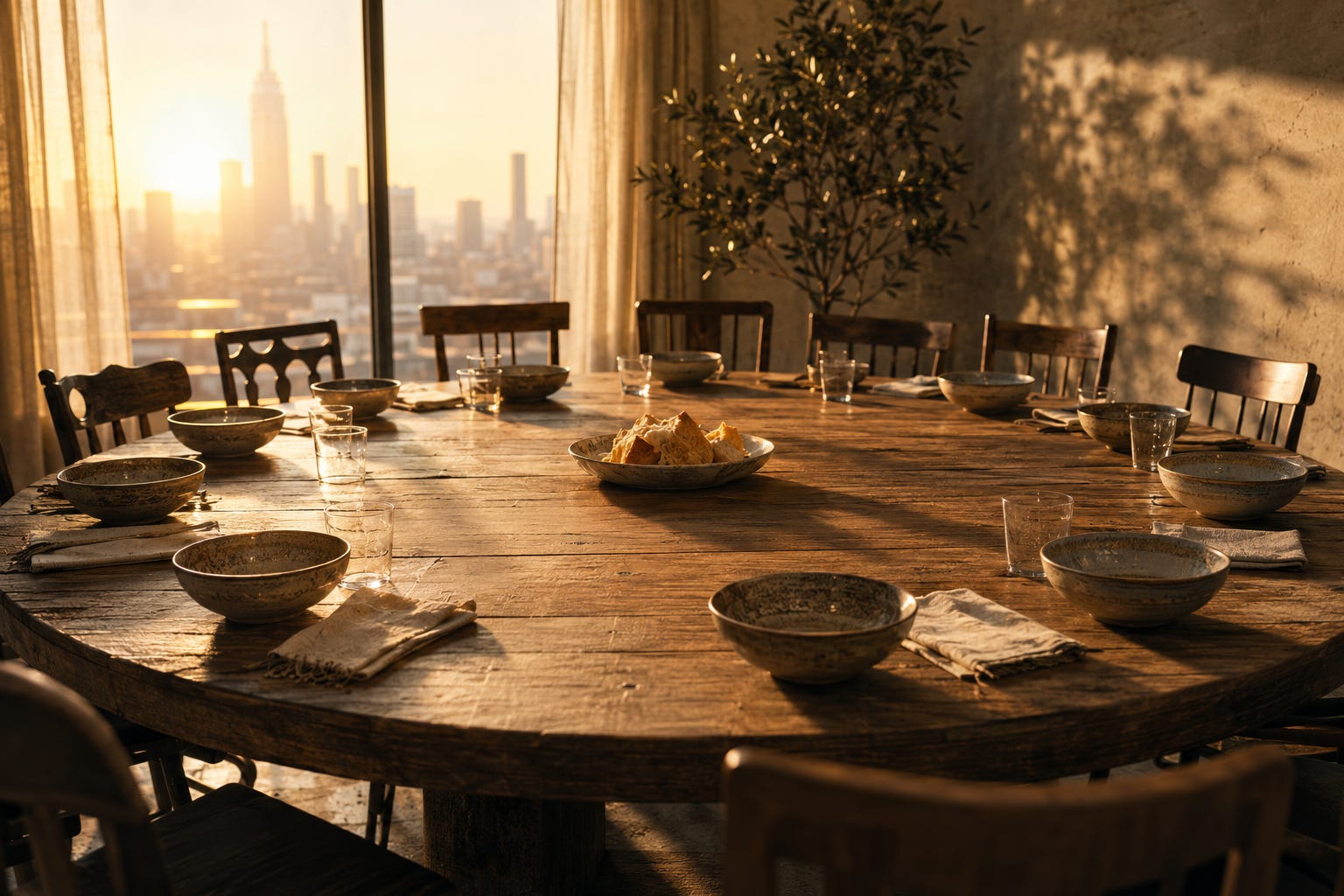
I mean that as literally as I can say it. A room in your building. A dozen chairs. Food, because people are more honest when they are eating. No cameras, no press release, no dais, no order of service. One evening, and then another one, and then another one after that.
That is the whole program. It sounds absurdly small next to the size of what we are facing. It is the only thing I have ever seen work.
Because here is what I have learned watching this for a lifetime: the world does not change at the level of statements. It changes at the level of rooms.
Two people who have been taught to fear each other sit at the same table, eat the same food, and discover that the other one has a daughter with the same illness, or the same fight with his own community, or the same fear about what is coming. Nothing in a communiqué does that. Nothing in a resolution does that. It happens at the table or it does not happen.
Which brings me to the hard part, and I want to be blunt about it, because this is where most interfaith work quietly fails.
A table of people who already agree is not a table. It is a dinner party.
We are all very good at convening the people who already like us. It is pleasant. It produces warm photographs and lovely feelings and absolutely no change whatsoever, because nothing in that room was ever at risk. Everyone arrived agreeing and left agreeing and the world outside the room went on exactly as before.
The table that matters is the one that includes the person you have a fundamental disagreement with. Not a stylistic disagreement. Not a difference of emphasis. The one whose position you find genuinely wrong, whose community has said things about yours that you have not forgiven, whose presence at your table will require you to explain yourself to your own people afterward.
That is the table where something can actually move. There is no other kind.
Peace is not made among those who agree. It is made among those who do not, at a table somebody had to set.
I know exactly how that sounds, so let me say what I am not asking. I am not asking anyone to pretend the disagreement is small, or to soften what they believe, or to arrive prepared to concede. Nobody is required to leave that room having changed their mind. Conversion is not the purpose and it never works anyway. The purpose is narrower and far more durable: that afterward, neither of you can go back to describing the other as a category. You will have met a person. It becomes very hard to hand your people a caricature of someone whose face you know.
That is not sentiment. That is the mechanism.
Hatred survives on abstraction, and a table is the machine that destroys abstraction.
Expect the first one to be uncomfortable. Expect somebody to say something that lands badly, and expect the silence afterward. Expect a member of your own community to ask why you are sitting with them. And expect to come home from the first evening certain that nothing was accomplished. You will be wrong about that. Something enormous was accomplished: the room existed. People who were not supposed to sit together sat together, and that was not true of your community the day before. Everything else that ever comes of it — every hard conversation, every friendship, every crisis that does not become a catastrophe because two leaders already knew how to call each other — is only possible because someone set the table the first time. That is the accomplishment. The rest is what grows on it. Trust does not arrive; it accumulates. But it has to have somewhere to accumulate, and you built that.
And then guard it, because trust takes a lifetime to build and a moment to destroy. This is the part nobody warns you about. Everything said at your table has to be safe there — not because you signed something, but because you are the sort of person with whom things are safe. Nothing you learn about another man’s community can ever be used against him, not in a sermon, not in an argument you are losing, not years later when it would be convenient. And when he is attacked — when his house of worship is defaced, when his people are slandered, when the mood of your own community turns against his — he has to be able to expect that you will say something, publicly, even when it costs you. Especially when it costs you. Nothing you have built together survives the moment he learns you went quiet.
I am aware of how idealistic that sounds. It is not idealism; it is the operating requirement. Integrity, sincerity, and the confidence that someone has your back no matter what — those are not the sentiments we hope will grow at the table. They are the conditions under which a table can hold anything at all.
And if you are wondering whether you are the right person to convene it: you are. That is the part I most want to be heard.
Religious leaders are uniquely equipped for this and I do not say that as flattery. You already have the room. You already have the standing to invite people who would ignore an invitation from anyone else. You are already trusted by a community that will follow where you go and notice where you refuse to go. You have spent your life in the presence of people at their worst moments and you are not frightened of a hard conversation the way most institutions are. Almost nobody else in your town has all four of those things. You have them today, without funding, without permission, and without waiting for anyone.
So the question is not whether it can be done. The question is whether you will do it, or whether you will assume that someone more important than you is handling it.
Nobody more important than you is handling it. That is the actual situation. The table gets steadied in ten thousand ordinary rooms by ten thousand people who decided not to wait, or it does not get steadied at all. Each one matters — not as encouragement, but as arithmetic. Every table is a place where the abstraction failed. That is how a thread gets picked back up: not by a movement, but by one person, and then another one, each deciding to hold their end of it.
What we are doing on August 29 is setting a table. That is all it is, and I want it understood exactly that way: one table, of a particular size, in a particular city, with people at it who do not agree with each other. Not a headquarters. Not the real table with the rest as practice. Ours seats a few dozen and lasts a morning; yours seats a dozen and can last a lifetime, which is why yours is the more consequential of the two. A morning in New York can say a thing out loud. Only a table in your own community can make it true where people actually live — on your street, in your city, among the people who will still be neighbors long after any summit has adjourned.
And if we can be useful to you in setting yours, that is what we are for. The World Council of Religious Leaders exists to serve, to facilitate, and to convene — to hold rooms open, to make introductions, and to carry what is said in them further than any one voice could carry it. Ask us. It is the work we are glad to do.
But please set yours regardless. Whether or not you ever come to New York, whether or not you have heard of us, whether or not anyone is watching. Most of the tables that will matter in the coming years will be convened by leaders whose names I will never learn, in towns I will never visit, and I have made my peace with that. It is not our work to do. It was never going to be.
It is yours. It always has been. And there is nobody standing between you and the first evening of it.
We were never given a seat at the table. We built it. Now please, go build one more.
Show up. Stand up. Speak up.
One World: One Humanity convenes August 29, 2026 in New York City, gathering eminent leaders from across the world’s faith traditions. Learn more at wcorl.org/oneworld.
Dear BAWA,
I couldn’t agree with you more! Thank you for sharing such an inspiring reflection and for reminding us of the power of the individual to take initiative and contribute to creating the world we wish to see. Your vision of “One Human, One World” is both timely and deeply meaningful.
I look forward to being part of this important dialogue and to exploring how each of us can take meaningful steps toward a more united and peaceful world.
Warmly,
Noushin